“I urge you to make a commitment to yourself and to Heavenly Father to dedicate your life and consecrate your time and talents to the building up of the Church of Jesus Christ in anticipation of the Savior’s Second Coming,
“Let the motive of your thoughts and actions be to glorify God and to bless your fellowman. Let this desire inspire you to greet each new morning with enthusiasm. Let it fuel your thoughts and actions throughout each day. If you do this, you will be blessed in the midst of a world that is fast losing its way, and you and your loved ones will be secure and happy.”
Elder M. Russel Ballard, Quorum of the Twelve Apostles. BYU-Idaho commencement (source)
Saturday, April 28, 2012
Wednesday, March 14, 2012
The Cost of Powerloss
Random story I thought was pretty funny.
Yesterday at work the power blipped out, then went out for a few hours. When my lab was sitting around we started estimating how much the department lost because of the lack of power. Use of the sequencing machines to generate genome sequences (i.e. DNA) cost about $40K a run and we had more than ten running at the time of the blip. So, with those runs, the preparation of samples for redoing the sequencing, salaries for the lab workers to reproduce these preps., and anything else that may have been running it easily could be half a million dollars lost in about two seconds. The supercomputers, including my own work, also shut down, so when power turns back on I will see what the damage is for me.
 The immediate response of most people was to run and check the -80º C freezers. When they found out theirs were not connected to emergency power, they were moved around quickly like bumper cars. These are very large freezers and it was hilarious to see corridors fill with these bulky objects (see left, which is normally clear). Everyone was looking for a non-standard plugs, powered by emergency generators, as the temperature rapidly increased for the precious samples held within.
My own difficulty came with the elevators being shut down. I work on the third floor so my plan was to wait out the power outage to avoid the stairs. Within 15 minutes the weather turned from sunny with blue skies to a snow squall. I decided that I had to take my chances with the stairs. As a result I will be down and out for the next few days; Gotta love neuropathic pain. Anyway I am home and safe with my doctor prescribed narcotics.
I will update with a picture of the hallway in its normal state when I get back in.
UPDATE: Here is the hallway in its normal condition:

Yesterday at work the power blipped out, then went out for a few hours. When my lab was sitting around we started estimating how much the department lost because of the lack of power. Use of the sequencing machines to generate genome sequences (i.e. DNA) cost about $40K a run and we had more than ten running at the time of the blip. So, with those runs, the preparation of samples for redoing the sequencing, salaries for the lab workers to reproduce these preps., and anything else that may have been running it easily could be half a million dollars lost in about two seconds. The supercomputers, including my own work, also shut down, so when power turns back on I will see what the damage is for me.

My own difficulty came with the elevators being shut down. I work on the third floor so my plan was to wait out the power outage to avoid the stairs. Within 15 minutes the weather turned from sunny with blue skies to a snow squall. I decided that I had to take my chances with the stairs. As a result I will be down and out for the next few days; Gotta love neuropathic pain. Anyway I am home and safe with my doctor prescribed narcotics.
I will update with a picture of the hallway in its normal state when I get back in.
UPDATE: Here is the hallway in its normal condition:


Saturday, March 10, 2012
Vainglory vs. the Glory of God
This week in Sunday School* I was reminded of an op-ed I read in The New York Times about the faith of a Jeremy Lin. I am not familiar
with Lin, other than he has been in a lot of headlines recently. I don’t follow
sports; I’m more of a nature documentary kind-a-guy. Anyway the thesis of the
op-ed was that the ethos of sports was entirely incompatible with the ethos of
religion. After thinking the article through we can really generalize his
argument to the statement that the ethos of competition or accomplishment in
the world is incompatible with the ethos of religion. He defines the ethos of
sports as:
…oriented around victory and supremacy. The sports hero tries to perform great deeds in order to win glory and fame. It doesn’t really matter whether he has good intentions.
Or in one word it values the
virtue of “courage” about all others, according to the article.
The religious ethos,
according to the author is “about redemption, self-abnegation and surrender to
God” with the primary virtue of “humility”.
He then concludes that
success and glory must be incompatible with humility and submission. I
disagree, though I understand the difficulty in integrating the two. My first
gut response was to think of a recent General Conference talk by President
Dieter F. Uchtdorf: “You Matter to Him”. Pres. Uchtdorf states:
“This is a paradox of man:
compared to God, man is nothing; yet we are everything to God. While against
the backdrop of infinite creation we may appear to be nothing, we have a spark
of eternal fire burning within our breast. We have the incomprehensible promise
of exaltation – worlds without end – within our grasp. And it is God’s great
desire to help us reach it.”
Pres.
Uchtdorf goes on to discuss two extremes in this paradox, believing we are
everything (pride), and believing we are nothing to anyone, including God. This
pride is equitable to the motivations ascribed to the op-ed’s ethos of sports.
And in the religious ethos God awards glory only as a result of submission to
God. But this paradox can turn the sports vs religion conflict on its head. We
are less than the dust of the Earth according to scripture,
but Heavenly Father wants to give us everything he has and give us a path to
succeed at what we do, so we can be greater tools in his hand.
Returning
to the original article, the author makes one big assumption that negates his
conclusion. When he writes of seeking success and glory, he implies that the
answer to the question ‘Why do we seek
such success?” is selfish ambition as the only goal. However, an alternative
response is that we are trying to glorify and love God with “all [our] mights, minds,and strength”. It is the first great commandment. This is consistent with the author's definition of
the ethos of sports i.e. “It doesn’t really matter whether he has good
intentions”, so if it doesn’t really matter to the world why you seek
accomplishments and glory then being motivated by service to our God is
acceptable under that ethos.
In fact I would argue that
the Lord does want us to become the best in our fields and that this is
entirely useful to Him. One letter to the editor responded to the article by saying “Therein lies
the tension: to strive for good things but not be consumed by them.”
One of my favorite examples
of this can be found in the book “The Essential James E. Talmage” (obviously
about Elder Talmage):
In late 1924 he was called to replace Elder David O. McKay as the head of the church’s European Mission…. Almost immediately he tried to visit with the editors of various newpapers to see if their anti-Mormon articles could be stopped. In one city he presented his calling card to a newspaper employee who gave it to his editor. At first the editor refused to see the Mormon apostle. But with the abbreviations F.R.S.E, F.R.M.S, F.R.G.S., representing the scientific societies of England of which he was a member, clearly visible, he could not be early ignored.
In this case the apostle was
able to get an advantage in the cause of God by having accolades in the world
of men. God wants us to do our best, and we do need to keep the focus on whom
we are serving and why we are doing it.
*After reading the scripture 2 Ne 27:19-23, and asking why Heavenly Father would chose an uneducated farm boy, the teacher followed up with the question (paraphrasing): "Does that mean the Lord only can use the uneducated and we shouldn't seek success?" We all answered in the negative.)
*After reading the scripture 2 Ne 27:19-23, and asking why Heavenly Father would chose an uneducated farm boy, the teacher followed up with the question (paraphrasing): "Does that mean the Lord only can use the uneducated and we shouldn't seek success?" We all answered in the negative.)
Elder Nelson: Healer
This is a very cool story from lds.org:
Dr. Russell M. Nelson was in Manzanillo, Mexico, in February 1978, attending medical meetings with the group of doctors he had graduated with 30 years earlier. Suddenly, one of the doctors became seriously ill, suffering from massive internal bleeding in his stomach. Under normal circumstances, any of the physicians in the room could have treated him. But in a remote fishing village with no hospitals nearby, no planes that could fly at night, and no medical equipment, they realized they were helpless as they watched their colleague suffer.
“All the combined knowledge and concern there could not be converted to action to help our friend as we saw his life ebbing before our eyes. We were powerless to stop his bleeding,” Elder Nelson said.
The man asked for a blessing. Several of the doctors who held the Melchizedek Priesthood immediately responded, and Dr. Nelson acted as voice. “The Spirit dictated that the bleeding would stop and that the man would continue to live and return to his home and profession.” The man recovered and returned home.
“Men can do very little of themselves to heal sick or broken bodies,” Elder Nelson said.
“With an education they can do a little more; with advanced medical degrees and training, a little more yet can be done. The real power to heal, however, is a gift from God. He has deigned that some of that power may be harnessed via the authority of His priesthood to benefit and bless mankind when all man can do for himself may not be sufficient.”
Wednesday, February 1, 2012
Zebras and Donkeys
There have been two articles that have really given me pause
recently. The first one seems to be very popular on Facebook from the
Washington Post.
I have chosen not to read it, as it seems to be very hate filled. The other
article seems a little less biased from Reuters, though in my opinion taping people without their
knowledge, which is what it seems, is wrong. I will not say too much specific
about the articles. One good response to the Post is found here.
My take on it is a bit different. Shouldn’t we expect these
things to happen? I mean are we not told all the time that people will ridicule
us for our beliefs? I am of course referring to Lehi’s dream.
People will come to the tree of life (love of God; sacrifice of Jesus Christ)
and some even partake of the fruit (gift of eternal life), but are later shamed
and walk away (1 Ne 8:24-28).
I personally have seen this happen with friends and family; it is one of the
hardest parts of living the gospel. Some whom we love and trust will reject the
gospel and some will go a step farther by turning, pointing, and mocking those
that have remained. The great and spacious building is active in our time. We
must never give up on loving them and doing our best to help them.
One issue I want to specifically address is the comment in
the Post’s article that says Church leaders say: “to quit reading historical
and scientific materials because they were ‘worse than pornography.’” That has
not been my experience, which of course is anecdotal. I was once in a church
meeting and speaking with a sister who started to berate someone as ignorant
because they believed in evolution. She found it surprising when I said that
not only do I study evolution I believe it to be true. Her response, “How are
you a member of the Church?!”
I didn’t know what to say, and was a little surprised. It
had only been a few years since I had left BYU, where I associated with many in
the Department of Biology where evolution is taught, researched, and advocated.
It bothered me, and as I was the Elders Quorum President (a local ministerial
position in the Church) I had regular interviews with my Stake President (he is
over about 6-9 congregations). I told him of my experience and during the
initial interview; he supported me saying that I need not worry about those who
question my church status because of my profession. Later he had some
questions about evolution news items and during the course of this email
conversation, he asked me to participate in a multistake youth conference and
teach the youth ages 14-18 about “Evolution and the Church”. So not only had my
Stake president been supportive, he wanted me to share what I knew with the
youth. It turned into a very spiritual experience for me both as I prepared and
shared my testimony of things important to me and I deem the event a success as
some of the youth had been struggling with these issues and my talk was a help.
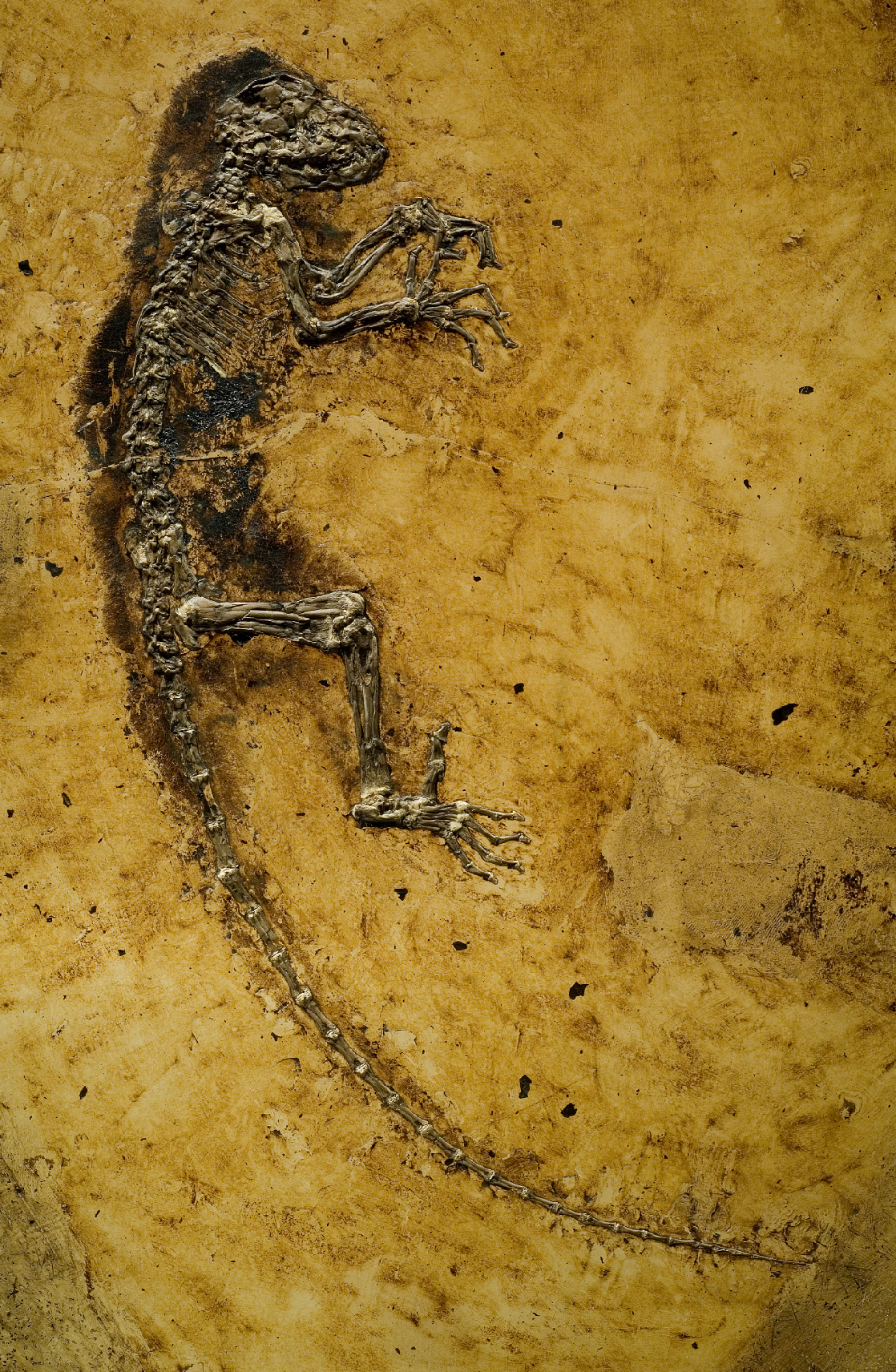 |
| Ida |
Further, an Area Authority Seventy (a member of the council
that oversees many stakes) was in attendance at the conference and in my class.
He was not only supportive of what I had to say; he had specific questions
about the science. He wanted to know about the then current news of Ida, a primate fossil that may or may not be a part of human evolutionary history (I
believe not, but that is a different story). It gave me a chance to teach a
little phylogenetics of primates
including how humans fit in.
When I have told others of this and other similar
experiences, I have heard the response that the openness was a result of where
I live, near universities. There may be some truth and I expect to have
“run-ins”, just as I have had positive experiences. This expectation comes because
I have already had unsympathetic interaction with some members. Since we are a
lay, theologically untrained, organization we do not always see the connections
between different beliefs. Some do not know what the church's position is on a
myriad of topics, myself included. When confronted with this situation I have
found that a principle of humility and love is essential.
I once worried I needed to "convert" those who
question my faith because of my profession, but I now realize they are what I
like to call zebras. Everything is black and white and since the important
stuff, namely the gospel principles, and faith in following the prophet are
usually in correct order for these people, I do not need to worry about their
acceptance/rejection of the theory of evolution. It is something important to
me, but I find most people do not think about it anywhere near as often as I do
and in the grand scheme of things it is not that important to our salvation. If
how God created the earth and all biodiversity were important to salvation it would
be explicitly spelled out like the essential aspects of the gospel, namely the first
principles and ordinances of the gospel, the atonement, and the importance of
the temple (here is great video of the temple).
Many in the Church are not zebras. I for instance feel more
like a donkey, grey all over with a white or black splotch here and there.
Zebras are incredibly important because they can move forward and protect what
is truly important in the gospel and testify unflinchingly about the truth God
has given us. They can be a great source of strength, as we look to their
testimonies to build our own. I think donkeys like me are also important as we
can help other donkeys and even some zebras in their search for truth. Donkeys,
as pack animals, have to work hard because we are constantly seeking, answering,
or identifying things we don’t understand. Those that say questions are
discouraged in the Church forget where the Doctrine and Covenants came from: answers to doctrinal questions. We should seek after constructive questions. That is
how we learn.
The difficulty is not allowing an answer to a question become
more important than living the “simple” aspects of the gospel. It can be
difficult at times especially when people answer a long pondered question in a
flippant way or state an answer like it is obvious. These types of response can
come from zebras where the answer is black or white, with nothing unresolved.
For me, three things help when dealing with question: 1) realize there are
others out there who also have questions, maybe even the same question; 2) learn
and keep reading, not fixating, but open to more information as it becomes
available; and 3) remember that by being open to new information we will eventually
receive answers to everything as the information becomes more pertinent to our
development and once it becomes the next line/precept and not many steps ahead, which are usually what I want.
Likely we are all really a mixture of zebras and donkeys,
depending on the topic. We need both zebras and donkeys in the Church and when
we band together to serve our Heavenly Father all are strengthened as we resist
the mocking sounds from the great and spacious building, to mix metaphors.
We should probably not respond like real zebras, though they do get along with real donkeys:
Monday, January 30, 2012
When I get on an airplane …
When
I get on an airplane I tend to talk to the people sitting next to me. I don’t
know if this is odd, but the people tend to be open to it. Eventually during
the course of the flight four topics tend to come up about myself: 1) my occupation, 2)
my disability, 3) my family, and 4) my religion.
I
am an evolutionary geneticist working on human genomics and have a PhD from Cambridge
University. It was a great experience where I focused my studies on the
molecular (DNA and proteins) evolution between species, specifically in
primates and mammals. I have since built on that experience by doing a
postdoctoral fellowship in population genetics (usually within a single
species) of humans using high throughput (that means a lot) genomic data. The
genome is all three million bases of DNA (genes, plus their context) in the
cells of our bodies. This latter work is particularly rewarding as it has
health and medical implications.
The
second area tends to focus on my disability. I walk with a limp and have used a
cane every day for the last few years. It usually comes up in conversation as I
have skipped in front of even the 1st class passengers with priority
boarding. My limp is a result of spina bifida occulta and a tethered spinal cord. If it sounds painful you are not mistaken. When
people ask when I “came down” with it I usually say at birth, though
technically it was before, but we didn’t notice till high school and then I had
spinal surgery. I tend to respond, when in pain, with some humor or light
heartedness to ease the tension I feel from those around me. I think it has
been confusing for some of my doctors when I tell them, I cannot walk, but then
laugh or make a joke.
I
also tend to be bull-headed about the pain as it motivates me to work harder. A
month after my surgery I was back running cross-country (without doctor
approval), though I was never any good, as a limp tends to make you a bit
slower. After my surgery the pain and leg strength were stable for quite a few
years. Two years into my PhD it acted up significantly. Neuropathic pain is not
fun: burning, stabbing, and electrical shock are not bad descriptions. As a
result I had to work from home for the last year of my PhD. To facilitate this our
family was blessed to have my sister-in-law live with us. Through the grace of
God, my loving family’s support, and many blessings from the priesthood of God,
I was able to finish in three years.
This
is why my family also inevitably comes up when speaking with new people. I am a
proud husband and father of three. I have a great family that provides no end of
happiness to my life. I was odd in graduate school as I started with one child and
had a second while still in school, and now as a postdoc we had a third. They
really are the joy of my life.
The
last area of my life, which inevitably follows from stating I have three
children at such a “young” age, is that I am a Mormon (www.mormon.org). I have
been a member of The Church of Jesus Christ of Latter-day Saints (LDS) all my
life. But I am not a member because of others, I am a member because I have personal
knowledge of my Heavenly Father as well as faith and trust in Him. I have had
to rely on Him constantly, because of my personal trials and I feel a close
connection to Him. I am a follower of Jesus Christ and do my best to live up to
that commitment. I have decided to start this blog to that end. It is my hope
that something I blog about will help others in their journey to return to live
with God through the saving grace and atonement of Jesus Christ. It is only by
Him that we can be saved and I feel it is my responsibility to make an active
effort in helping God our Heavenly Father and His Son in their mission to redeem
mankind (Moses 1:39).
I
can’t do much, but I can bare witness to the miracles I see every day both in
the natural world, as well as the workings of God in my life. I am a scientist
so I am privileged enough to explore the hand of God in my occupation. I am
also a mortal being with my share of physical trials, so I get to see how God
can lift me up, comfort me, and give me the strength to do all things he
commands of me (1 Ne 3:7; 17:50).
My hope for this blog is that someone, somewhere will feel the testimony I try to
convey, and come just a little bit closer to God.
Subscribe to:
Posts (Atom)